Be Informed
Sign up for Sépaq emails to be the first to find out about our promotions, news and special offers.
Having extensive knowledge of the parks to better preserve them is the foundation that justifies the efforts invested in inventories, monitoring programs and scientific research. At Parc national des Grands-Jardins, for the past 15 years, Université Laval’s Northern Studies Centre has been studying the origin and dynamics of spruce lichen, the impacts of natural disturbances on them, and the frost hollow phenomena.
Following the fires of 1991 and 1999, several researchers studied plant recolonization and the use of recently burned sites by several animal species, such as the Black Woodpecker and the Whitespotted Sawyer.
Since the summer of 2000, the Canadian Wildlife Service has been monitoring the effect of lake acidification in the park on loon breeding success.
More recently, a research group on peatbog ecology started a study to determine conditions for recolonizing disturbed northern environments
Find out more about scientific research in the Québec's National Parks network
What could be more tempting than a dead tree to feed your campfire?However, if you give in you are depriving hundreds of species of an important source of food and shelter. Thank you for respecting the rule, since for forest life, a dead tree is worth its weight in gold.
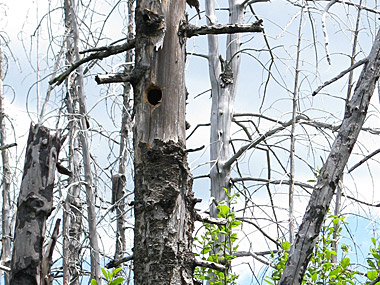
LDead trees are as useful as living trees. But who’s the tenant here? Photo credit: Adine Séguin
In a recently burned forest, the Black-Backed Woodpecker digs a deep cavity into a dead tree that’s still standing to raise her family. Research done in the park shows that even 10 years after the fire, Western bluebirds, bats and red squirrels still use this network of cavities abandoned by the woodpeckers.
Once the dead trees are lying on the ground, they become host to many insects and fungi that serve as food for amphibians, small rodents and even black bears.
Sign up for Sépaq emails to be the first to find out about our promotions, news and special offers.